

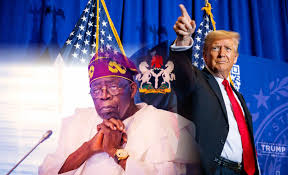
The President of the United States, Donald J. Trump, has issued a warning to the Federal Republic of Nigeria, stating that the United States may deploy military forces to Nigerian territory should the alleged acts of genocide against Christians persist.
In a statement published on his Truth Social account on Saturday, President Trump directed the Department of War to make contingency preparations for “possible action” in the event that the killings continue unabated.
The U.S. President further declared that all financial aid and assistance to Nigeria would be suspended should the administration of President Bola Ahmed Tinubu fail to bring an end to what he described as the persecution and killing of Christians.
Quoting directly, Trump stated:
“If the Nigerian Government continues to allow the killing of Christians, the United States will immediately stop all aid and assistance to Nigeria, and may very well go into that now disgraced country, ‘guns-a-blazing,’ to completely wipe out the Islamic terrorists who are committing these horrible atrocities.
I am hereby instructing our Department of War to prepare for possible action. If we attack, it will be fast, vicious, and sweet, just like the terrorist thugs attack our cherished Christians.”
As of the time of this report, the Federal Government of Nigeria had not issued an official response to the statement.
Nigeria’s Official Response
President Bola Ahmed Tinubu rejected the United States’ designation of Nigeria as a “Country of Particular Concern,” describing the action as a misrepresentation of Nigeria’s commitment to religious freedom.
In a statement released via his official X (formerly Twitter) account on Saturday, President Tinubu affirmed that Nigeria remains a democracy governed by the rule of law and constitutional guarantees of religious liberty.
“Nigeria stands firmly as a democracy governed by constitutional guarantees of religious liberty. The characterisation of Nigeria as religiously intolerant does not reflect our national reality,” the President stated.
He added that religious tolerance and freedom constitute “core tenets” of Nigeria’s identity and governance, asserting that the government remains committed to protecting all citizens irrespective of their faith.
The Spokesperson for the Ministry of Foreign Affairs, Kimiebi Ebienfa, confirmed that Nigeria has commenced diplomatic engagements with the United States to address the matter, noting that discussions were ongoing through Nigeria’s missions in Washington D.C., Atlanta, and New York, as well as the U.S. Embassy in Abuja.
Legislative and Diplomatic Developments
A ranking member of Nigeria’s House of Representatives disclosed that a parliamentary delegation was scheduled to travel to Washington to engage with members of the U.S. Congress concerning the designation. The visit, initially planned before Trump’s announcement, will now be expedited.
The legislator clarified that the U.S. President’s designation of Nigeria as a “Country of Particular Concern” is not self-executing and would require congressional approval to assume the force of law.
Reactions and Commentary
The Special Adviser to the President on Information and Strategy, Mr. Bayo Onanuga, dismissed the allegations of genocide against Christians as “grossly exaggerated.” In a response to U.S. Secretary of State Marco Rubio, who had alleged that Fulani militias and radical Islamists were perpetrating mass killings of Christians, Onanuga stated:
“Dear Secretary Rubio, there is no ongoing slaughter of thousands of Christians in Nigeria. What we do have are sporadic attacks on villages by bandits and terrorists, and these attacks are not religiously motivated. Christians, Muslims, churches, and mosques are attacked indiscriminately.”
He further urged the United States to support Nigeria’s counter-terrorism efforts through military assistance rather than punitive designations.
Expert Analysis
A former Nigerian Ambassador to the Philippines, Dr. Yemi Farounbi, cautioned that the U.S. declaration could adversely affect Nigeria’s diplomatic reputation and international partnerships. He observed that the designation may portray Nigeria as a country hostile to religious liberty, with potential implications for economic cooperation, security collaboration, and international aid.
“This development could make the United States and its allies perceive Nigeria as a nation where freedom of worship is not protected. The implications for our image and diplomatic relations could be severe,” Farounbi stated.
He advised the Nigerian Government to provide verifiable evidence of its ongoing efforts to prosecute perpetrators of sectarian violence and ensure equal protection for all religious groups.
Security and Defence Relations
According to data from the Stockholm International Peace Research Institute (SIPRI), Nigeria remains one of Sub-Saharan Africa’s leading importers of military hardware, sourcing weapons primarily from the United States, China, Italy, Turkey, and Russia.
Notable acquisitions include twelve A-29 Super Tucano light attack aircraft procured from the United States under a $500 million agreement in 2018 and a subsequent $997 million contract for twelve AH-1Z attack helicopters approved in 2022. In August 2025, Washington approved an additional $346 million potential sale to Nigeria, further reinforcing bilateral defence ties.
Data from the National Bureau of Statistics indicate that Nigeria expended ₦777.1 billion on arms imports between 2020 and 2024, and ₦26.95 billion in the first half of 2025 alone.
Religious and Civil Society Reactions
The Catholic Bishop of Sokoto Diocese, Most Rev. Matthew Hassan Kukah, urged citizens to exercise restraint and avoid emotional responses, noting that the implications of the U.S. declaration should be assessed objectively.
“We must observe developments calmly and determine what lessons can be drawn for national cohesion and governance,” Bishop Kukah stated.
Similarly, the Regional Leader of the Church of Christ in Nations, Evangelist Ezekiel Dachomo, described the designation as a validation of longstanding concerns regarding religious persecution in Nigeria.
“The world is finally acknowledging the plight of Nigerian Christians who have suffered years of violence without adequate protection,” Dachomo declared, adding that both Christians and Muslims must work together to preserve peace and unity in the country.#newsafro_
